The Amex Blue Cash Preferred, Our Everyday Grocery Card: 6% Back
Our grocery cash-back setup runs on two Amex cards: the BCP paying 6% back at grocery stores, and a no-fee BCE catching the spend past the cap at 3%. How much grocery spending makes the $95 annual fee genuinely worth it, and which card fits your family — it's all here.
Our main grocery card is the Blue Cash Preferred (BCP) from American Express, the one in the Blue Cash line that charges an annual fee: 6% back at U.S. grocery stores for $95 a year, waived the first year. I’ve held it for three years, and it’s still the best-value card in the house. The grocery tier alone leaves us over two hundred dollars a year after the fee.
When I first got it, friends asked why anyone would pay an annual fee on a cash-back card. My answer: run the numbers first, then we talk.
6% at grocery stores sounds great — mind the cap
Six percent is generous, but it only counts at U.S. grocery stores, on the first $6,000 per year. Past that, it drops back to 1%. And there’s a trap people hit: the grocery-store category doesn’t include big-box supermarkets like Walmart or wholesale clubs like Costco, so a run there earns nothing special.
Here’s what it looks like for us. Our groceries mostly come from a local Chinese grocery store, HEB, and delivery platforms like Weee! and Yamibuy, which conveniently all count as grocery stores on our statements. Last year we just kept ordering, and when I totaled it up at year-end we’d spent about $8,000 at grocery stores, blowing through the $6,000 cap for the first time. This year we have a newborn and my parents are coming to stay, so we’re cooking more. The number is only going up.
Is the $95 annual fee worth it
There are two lines worth knowing.
The first is the payback line. To earn back the $95 fee at 6%, you need about $95 ÷ 6% ≈ $1,583 of grocery spending a year — call it $1,600, roughly $130 a month. Reach that and the fee isn’t wasted — but to actually beat a no-fee 3% card like the BCE, you’d need to spend more than $3,167 a year at grocery stores.
Here’s where that number comes from. A no-fee card pays 3% at grocery stores with nothing taken off the top — that’s pure money. All the BCP adds is three extra points, and those three points have to earn back the $95: $95 ÷ 3% ≈ $3,167, about $264 a month.
If your household spends less than $3,000 a year at grocery stores, don’t chase this card. A no-fee Blue Cash Everyday (BCE), which also pays 3% at grocery stores, or any no-fee 2% flat card, is a better fit.
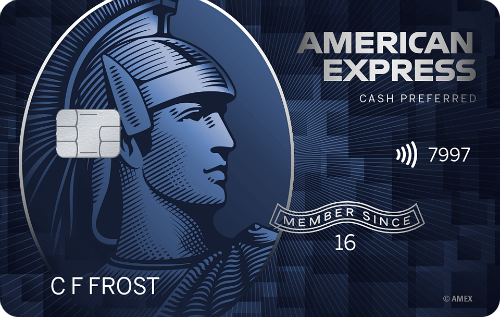 Cash back
Amex Blue Cash Preferred
- ✓6% at U.S. grocery stores on the first $6,000 per year, then 1%
- ✓6% on select streaming subscriptions, no annual cap
- ✓3% at U.S. gas stations and on transit (rideshare, tolls, parking count)
- ✓Up to $10 back each month on Disney+ / Hulu / ESPN+ billed directly (up to $120 a year)
- ✓Cash back applies as a statement credit or 1:1 at Amazon checkout
Run our numbers against those lines: last year’s $8,000 more than doubles the $3,167 one. Even just counting the grocery tier at the cap, $6,000 × 6% = $360, which leaves $265 after the $95 fee — before counting the 3% tiers on gas and transit. I let the cash back pile up and knock down one big statement every so often; statement credit and Amazon checkout both work at 1:1.
When you blow past the $6,000 cap
Blowing past $6,000 a year at grocery stores isn’t unusual — for a family of three that cooks most meals, $6,000 is only about $115 a week, and it adds up fast. Past the cap, the overflow earns just 1%, so it’s worth thinking about how to handle it.
On last year’s $8,000, the roughly $2,000 above the cap earned about $20 at 1% — the same money would have been $60 at 3%. This year the overflow will only be bigger. And it happens that this year an AC repair made a 0% APR window attractive, so I opened a no-fee BCE (the full story is here) — which pays 3% at grocery stores, and has quietly been catching whatever grocery spend the BCP can’t cover at 6%. It started as a stopgap; it turned into a regular partner.
And if a year ever really lands at the $12,000 tier, catching overflow at 3% stops making sense. The cleaner move is having your spouse open their own BCP — two cards, two independent $6,000 caps, both earning 6%.
Honestly, there’s no drama to this card. The rules are right there: 6% at grocery stores on the first $6,000 a year, a $95 annual fee waived the first year. If your household spends $3,000 or more a year on groceries, it’s worth considering; if not, a no-fee BCE or a 2% card will treat you fine. It’s not a miracle card — just one that pays you back when you actually buy groceries.
This article is a record of my personal experience and personal finances; it does not constitute investment or credit card advice. Rewards structures, welcome offers, fees and spending requirements are subject to Amex’s current official terms; the BCP’s 6% grocery-store rate applies at U.S. grocery stores on the first $6,000 per year and drops to 1% beyond that.